Kings College Hospital funded an Art programme based in the Albany, Deptford for survivors of traumatic head injury. Cash Aspeek and Michelle Butcher set up the project, later joined by Kristina Page to form a therapeutic Art Open Studio.

We want to encourage participants to see themselves as a fount of information and knowledge about the real world. When they are encouraged to work with the knowledge they have from their own experience they can develop strategies together to change their immediate situations. ( Ah-Hah! By Gatt Fly 1983)
The project forms part of a social rehabilitation programme for people with acquired brain injury. The service users are adults who have had mostly single incident brain injuries as the result of an assault, accident, stroke or infection.
Brain injury survivors may have trouble focusing or concentrating,
have short-term memory problems and become easily frustrated or upset. They may tire quickly and have slower speeds of cognitive processing, making it difficult to function at the pace demanded by their prior work environments. Yet their brain injury may not be apparent either visually or clinically. Often, survivors look the same as ever – it is on the inside that they are different, and their injury is invisible. (Crisp1994, Prigatino 2000)
“The aims are to increase social participation and therefore “Wellness” in people with primarily cognitive impairments although some people may also be living with physical disabilities as well.”
Short-term goals of the larger project are:
- To build and sustain the community of people recovering from brain injuries and their families.
- For brain injured people to have ownership of a service that understands and supports them.
- To provide an enjoyable and broadly “therapeutic” environment.
- To link the art project in with the person’s wider goals for their rehabilitation.
Medium term goals:
- To explore the possibility of “making” as part of a vocational rehabilitation programme.
- To formalise and evaluate the programme as a wider part of the social rehabilitation centre.
- To establish a methodology for evaluating the outcome of the programme in terms of measures of “Wellness”, “rehabilitation outcome”, social return on investment.
- To raise the profile of brain injury within the wider community.
(John Ling, Clinical Nurse Specialist: (Brain Injury/Neurovascular) of King’s College Hospital London)
Twelve workshops were delivered by Cash Aspeek and Michelle Butcher.
We worked with the participatory model. Everybody who came to an art workshop became a participant whether they were a member, a support worker, a member of staff, or indeed the art facilitators. We were all committed to listening to each other and sharing knowledge.
For each workshop we experimented with a new technique to express ourselves creatively and we also left space for anyone to direct us to another technique or revisit a previous one.
The sessions began by working silently on short, collaborative, creative exercises in order to make some artwork without any pressure. This approach was spontaneous, about communication and movement. It required concentration and commitment to the short time it took to make the work. This created an opportunity to talk about this experience. The sharing of these experiences created the structure for most of all the twelve sessions as it seemed a good way to everyone to express themselves.
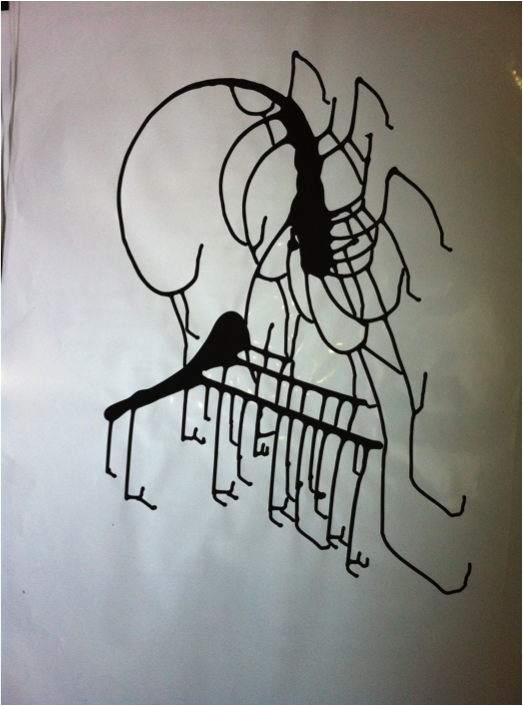
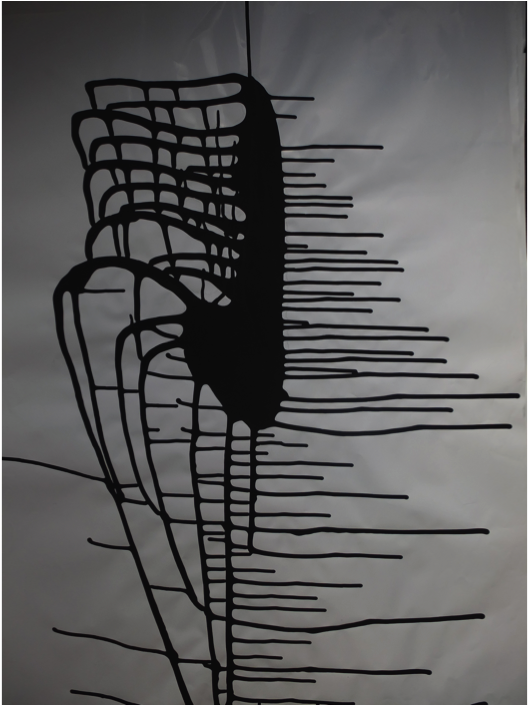
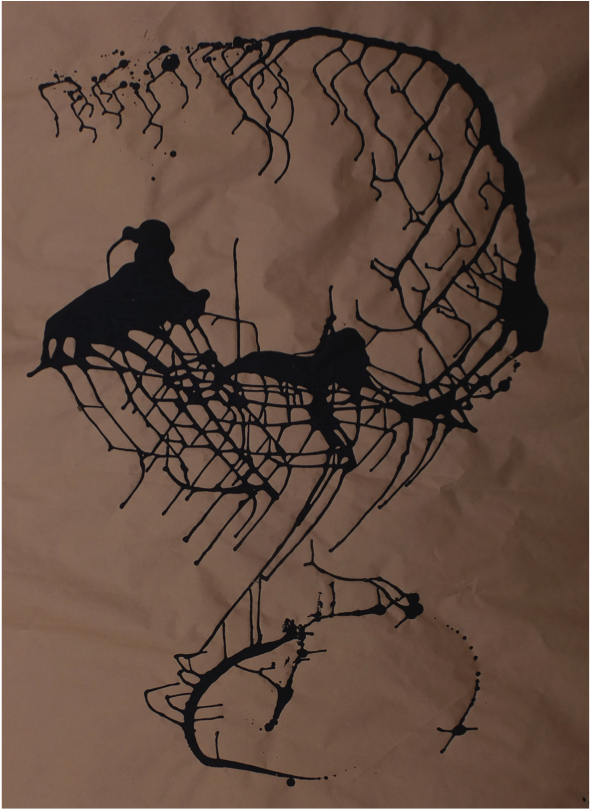
Paint Rolling The two on the left were made in pairs, by pouring paint and allowing it to move around the paper by holding two corners each. The image on the right is 8’x4’ and created by four people. Many refer to it as the brain. This activity was very popular.